A manufacturer's glossy brochure and the same manufacturer's instructions for use are both official documents about the same device. They are not interchangeable, and a system that treats them as one category of thing will eventually publish a clinical claim on the strength of a sales page.
That is the idea underneath evidence-based content, and it is more specific than the phrase suggests. It is not enough for a statement to have a source. The source has to be the kind of thing that can settle that particular question.
Three Questions That Get Treated as One
Almost every argument about evidence in product content collapses because three separate questions are being answered as though they were one.
- Does this source exist, and is it what it says it is?
- Is it about this product, this model, this part number?
- Does it support this particular claim?
A tool can pass the first two convincingly and fail the third on every sentence. Retrieval systems are generally good at the first, decent at the second, and mostly silent about the third, which is why so much sourced output falls apart when someone actually opens a link.
The Four Tiers, in the Order They Are Trusted
GearDock sorts everything it holds into 4 tiers. The order is the thing to notice, because it is not the order most people expect.
| Tier | What it is | Typical example |
|---|---|---|
| Tier 1 | Verified internal evidence | A document somebody on your team reviewed and attached to this product. |
| Tier 2 | Regulatory record | An FDA, GUDID, or CE and MDR record for the device itself. |
| Tier 3 | Manufacturer document | The manufacturer's own instructions for use, service manual, or datasheet. |
| Tier 4 | Secondary source | A dealer listing or third-party page. Held, but not trusted on its own. |
Why Your Own Document Outranks the Manufacturer
Putting the seller's own file above the manufacturer's website looks wrong at first glance, and the reasoning is worth stating plainly. A Tier 1 document is not trusted because it is yours. It is trusted because a person made two decisions about it: that this document is genuine, and that it belongs to this product.
Neither of those decisions is available anywhere else in the chain. A page found on the open web arrived because a crawler reached it. A regulatory record is authoritative about its own contents and frequently says less than a catalog needs. The manufacturer's site is authoritative and is also a marketing surface where the console, the software tiers, and the accessories share a page. A human being deciding this file describes this device is the strongest signal in the system, and it is the only one that carries accountability with it.
This Is Also Why Attaching Documents Changes the Output So Visibly
Which Claims Each Tier Is Allowed to Carry
Tier alone is not the rule. Statements are sorted into 9 classes, and each class has a floor: the lowest tier of source competent to carry it. A specification can rest on the manufacturer's own documentation, which is what a catalog is normally written from. A regulatory status cannot.
| Class of statement | Lowest tier that may carry it | Why |
|---|---|---|
| Regulatory status | Tier 2, regulatory record | A brochure saying FDA cleared is the manufacturer's marketing, not a clearance. The register is the record. |
| Clinical use | Tier 2, regulatory record | What a device is indicated for is a regulated statement, not a positioning statement. |
| Product identity | Tier 3, manufacturer document | The manufacturer is authoritative about what its own model is called and numbered. |
| Specification | Tier 3, manufacturer document | Datasheets and manuals are where real figures live, and they are usually complete. |
| Compatibility | Tier 3, manufacturer document | What works with what is established by the manufacturer, not inferred from a shared family name. |
| Performance | Tier 3, manufacturer document | A performance figure without a documented measurement is a sales claim. |
| Safety | Tier 3, manufacturer document | Permitted from official documentation, with one exclusion below that applies regardless of tier. |
| Materials | Tier 3, manufacturer document | Material composition matters for sterilisation and sensitivity, so it needs the document rather than the listing. |
| Description | Tier 4, secondary source | Wording that carries no product fact. Free to write, and labelled as wording only. |
Read down that table and a familiar catalog problem resolves itself. The reason a device page can be rich on specifications and thin on clinical language is not that the writing gave up. It is that the two sit on different floors, and only one of them was reachable from the evidence on hand.
Some Documents Are Excluded Whatever Tier They Reach
Tier is about where a document came from. It says nothing about what kind of document it is, and that turns out to matter independently.
A brochure published on the manufacturer's own site reaches Tier 3 honestly. It still cannot establish an intended use, a regulatory status, or a safety statement, and the reason is that sales material paraphrases the instructions for use. The paraphrase is exactly where clinical overreach enters a catalog, because it is written to be persuasive by people whose job is not to constrain it.
- Instructions for use
- May carry clinical and safety statements. This is the document those statements come from in the first place.
- Service manual and datasheet
- Specifications, compatibility, materials, performance. The densest and most reliable source of real figures.
- Brochure
- Fine evidence that a device exists and what it is called. Refused for clinical use, regulatory status, and safety, at any tier.
- Regulatory record
- Authoritative about its own contents, including status and identifiers, and frequently silent about everything a buyer wants to know.
Discovery Is Not Evidence
Tier 4 exists so that material can be held without being trusted. That distinction sounds academic until you watch what happens without it. A system with no Tier 4 has two options for a dealer listing it found: treat it as a source, or throw it away. The first is how third-party specifications end up asserted as fact. The second means the system cannot show you what it looked at.
Holding it lets both things be true. The listing is visible, the reader can follow it, and no statement rests on it. Nothing becomes evidence by being found.
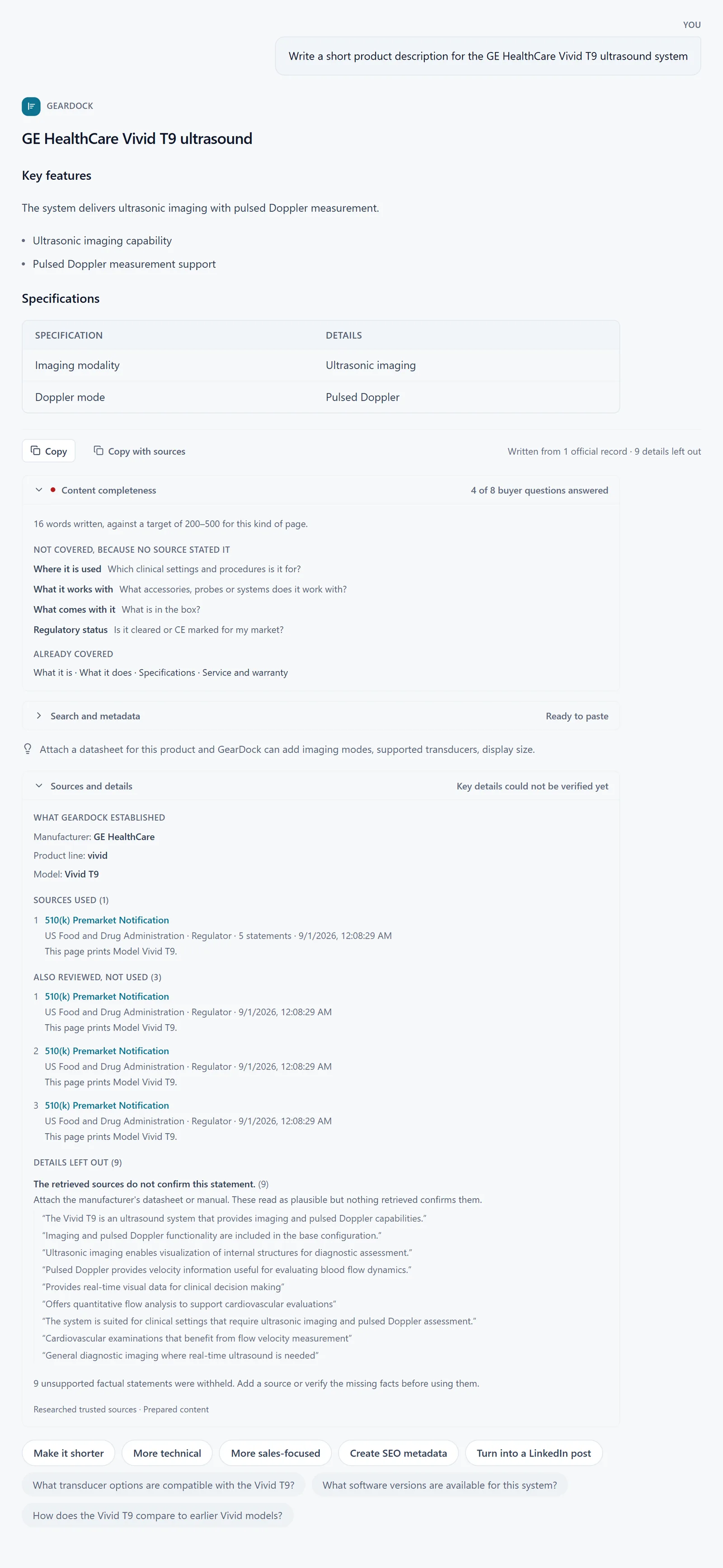
What a Refusal Looks Like
When a source cannot carry a claim, the refusal is written in ordinary language rather than logged as a code somewhere a reviewer will never look. A compatibility statement resting on a secondary source comes back saying so: a compatibility statement needs a manufacturer document or better, and this is a secondary source. A clinical statement resting on a brochure comes back saying a brochure cannot establish clinical use.
Those sentences are doing more work than they appear to. A reviewer reading them learns what the system would accept, which means the next action is obvious: attach the instructions for use, or drop the sentence. A refusal that says insufficient evidence teaches nothing and gets overridden.
The Failure This Whole Structure Exists to Prevent
What This Changes in Practice
Three things follow from tiering evidence this way, and all three are operational rather than philosophical.
- Gaps become specific. Instead of a product that needs more work, you get a product whose clinical section is empty because no Tier 2 record is attached, which is a task somebody can actually do.
- Document collection gets a priority order. If most of your gaps are clinical and regulatory, chasing more brochures will not close a single one, however many you find.
- Disagreements resolve on a rule rather than on whoever edited last. When two sources conflict, the tier decides, and the decision is the same one every time and inspectable afterwards.
Where This Stops
Tiering is a competence rule, not a truth oracle. A Tier 2 record can be out of date. A manufacturer can publish an error in its own datasheet and leave it up for years. A correctly tiered, correctly classified, correctly admitted statement can still be wrong, and no arrangement of sources fixes that.
What it does fix is the class of error where nobody could have known. When a statement is wrong and you can see which document it came from and what class of claim it was admitted as, the correction is bounded and repeatable. That is the whole of what evidence-based means here, and it is worth saying out loud rather than letting the phrase imply more.